If you’re an AT&T internet subscriber — whether that’s AT&T Fiber, U-verse, or an older DSL connection — 192.168.1.254 is almost certainly your router’s login address. I see a lot of people trying 192.168.1.1 and getting nowhere because they didn’t know AT&T uses a completely different default gateway. This guide covers everything: logging in on a computer or phone, the exact credentials for AT&T and other brands that use this IP, what to do when the page won’t load, and what to actually change once you’re inside.
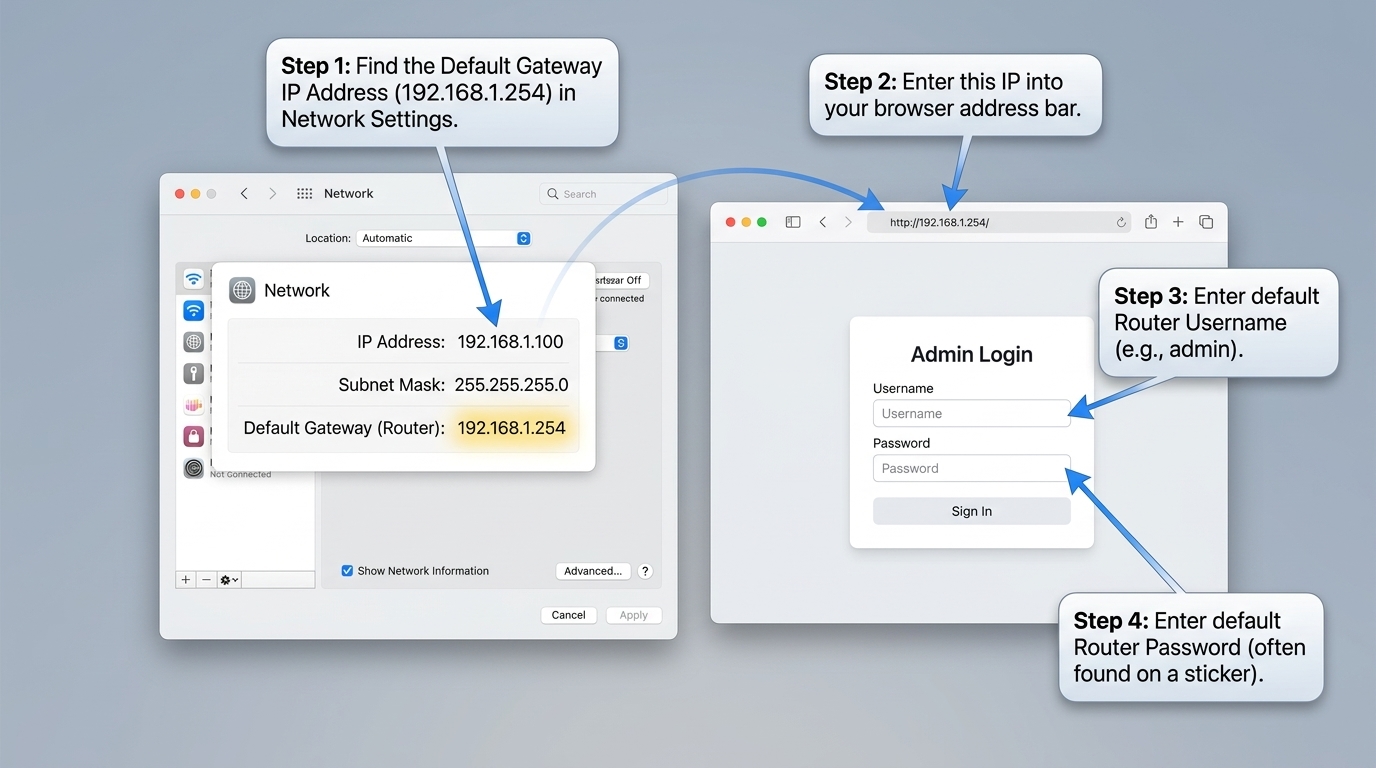
192.168.1.254 – Router Login Admin Page
What Is 192.168.1.254?
192.168.1.254 is a private IP address used as the default gateway on several router models — most notably AT&T’s residential gateways (including the BGW210, BGW320, NVG510, NVG599, and older 2Wire/Pace hardware). It’s also used by some BT and PlusNet equipment in the UK, as well as select models from Alcatel, Linksys, and 2Wire.
Like all private IPs, 192.168.1.254 only works on your local home network. You can’t reach it from outside — it’s not on the public internet. Type it into your browser while connected to your home Wi-Fi, and you’re talking directly to your router or gateway.
The address sits at the very top of the standard 192.168.1.x subnet. Most home routers that use this subnet pick 192.168.1.1 as their gateway — but AT&T made a deliberate choice to use .254 instead, placing it at the other end of the range. This is why guides written for other routers won’t work for AT&T customers who try them.
The address is defined within the private IP space established by RFC 1918 — specifically the 192.168.0.0/16 block reserved exclusively for private network use. No public website will ever have this address.
When you type 192.168.1.254 into your browser, it opens your gateway’s admin panel — the control center for your home network. That’s where you can change your Wi-Fi name and password, view connected devices, configure parental controls, set up port forwarding, update firmware, and manage your AT&T account-specific settings.
Default Username and Password for 192.168.1.254
The credentials you need depend on your specific device. AT&T gateways handle this differently from most home routers — the password is usually unique to your device, printed on a label, rather than a generic factory default.
| Brand / Device | Default Username | Default Password |
|---|---|---|
| AT&T BGW210-700 | admin | Located on device label |
| AT&T BGW320-500 / 505 | admin | Located on device label |
| AT&T NVG510 | admin | attadmin |
| AT&T NVG589 | admin | attadmin |
| AT&T NVG599 | admin | attadmin |
| 2Wire 3800HGV-B | admin | admin |
| Pace 5268AC | admin | Located on device label |
| Alcatel SpeedTouch | admin | admin |
| BT Home Hub (UK) | admin | (blank) |
| PlusNet Hub (UK) | admin | (blank) |
| Linksys (some models) | admin | admin |
| Motorola (some models) | admin | motorola |
⚠️ Important: AT&T customers — On newer AT&T gateways (BGW210, BGW320, Pace 5268), the admin password is a unique alphanumeric string printed on a sticker on the side or bottom of the device — not a generic password like “attadmin.” Look for a label that says “Device Access Code” or “Admin Password.” That’s the one you need.
ℹ️ Info: Older AT&T devices (NVG510, NVG589, NVG599): These use admin / attadmin as the factory default, unless someone changed it during setup.
How to Log In to 192.168.1.254 on a Computer
These steps work on Windows and Mac, in any browser — Chrome, Firefox, Edge, or Safari.
- Make sure your computer is connected to your home Wi-Fi or plugged into the gateway with an Ethernet cable.
- Open any browser.
- Click into the address bar at the very top of the browser window — where the URL normally shows. Not the Google search bar.
- Type
192.168.1.254and press Enter. - The gateway login page appears. Enter your username and password.
- Click Login or Sign In.
- The admin dashboard loads. You’re in.
⚠️ Common mistake: Typing 192.168.1.254 into the Google search bar gives you search results — not your router. You need the address bar at the top. If the page fails to load, try http://192.168.1.254 with the http:// prefix — some browsers force HTTPS by default, which blocks router admin pages.
How to Log In to 192.168.1.254 on iPhone
Most competing guides don’t cover mobile at all. Here’s exactly how to do it on iPhone:
- Open Settings → Wi-Fi and confirm you’re connected to your home network. Mobile data won’t work here — only Wi-Fi.
- Tap the (i) icon next to your network name. Look for the Router field to confirm your gateway IP is 192.168.1.254.
- Open Safari or Chrome.
- Tap the address bar at the top and type
192.168.1.254. - Tap Go on the keyboard.
- The login page will load. Enter your username and device access code.
- Tap Login.
The AT&T gateway admin panel on mobile is fully functional — Wi-Fi settings, device list, parental controls all work from a phone browser. For advanced settings like firewall rules or IP passthrough, a desktop browser is more comfortable but not required.
How to Log In to 192.168.1.254 on Android
- Go to Settings → Network & Internet → Wi-Fi and connect to your home network. Disable mobile data if it keeps overriding your Wi-Fi connection.
- Tap your network name → Advanced → look for Gateway. Confirm it shows 192.168.1.254.
- Open Chrome or any browser.
- Tap the address bar and type
192.168.1.254. - Tap Go.
- Enter your credentials on the login page.
- Tap Login.
ℹ️ Note: On Samsung devices, the path is sometimes Settings → Connections → Wi-Fi. The exact location depends on your Android version.
Troubleshooting: When 192.168.1.254 Won’t Work
Almost every login problem falls into one of these five categories.
Problem 1: Page Won’t Load — Blank Screen or “Site Can’t Be Reached”
Cause: You’re not connected to your home network, you typed it into the search bar instead of the address bar, or your browser is defaulting to HTTPS.
Fix: Confirm you’re on home Wi-Fi (not mobile data). Make sure you’re clicking the address bar — the bar at the very top of the browser, not the search field. If the page still won’t load, type http://192.168.1.254 with the http:// prefix. This forces the browser to use the correct protocol. Some modern browsers will try HTTPS automatically, which will fail for a router admin page.
Problem 2: Wrong Username or Password
Cause: AT&T’s newer gateways (BGW210, BGW320) use a device-specific access code — not a generic default. If you’re typing “admin / attadmin” and getting rejected, this is why.
Fix: Check the label on the side or bottom of your AT&T gateway. Look for “Device Access Code” or “Admin Password” — it’s a string of random characters unique to your device. That’s your password. If the label is worn off or unreadable, an AT&T account holder can also find the gateway’s admin password in the AT&T Smart Home Manager app under Gateway settings.
Problem 3: 192.168.1.254 Is the Wrong IP for Your Router
Cause: If you have a personal router plugged into your AT&T gateway (a common setup), your personal router likely uses a different IP — such as 192.168.1.1 or 192.168.0.1. Typing 192.168.1.254 will reach the AT&T gateway, not your personal router.
Fix: Decide which device you actually want to configure. To find which IP each device uses, run ipconfig on Windows (look for Default Gateway) or check Settings → Wi-Fi on iPhone (look for Router). If you want to access your personal router, use its IP. If you want the AT&T gateway, use 192.168.1.254 — but make sure you’re connected to the AT&T Wi-Fi network, not the network created by your personal router.
Problem 4: AT&T Gateway Shows Login Page But Rejects All Credentials
Cause: The admin password may have been changed by AT&T during a firmware update, or by a family member who set it up originally.
Fix: A factory reset restores the original device access code from the label. On AT&T gateways, hold the Reset button for 10 seconds. After the reboot, use the access code from the label on the device. If the label is missing and a reset doesn’t help, AT&T support can assist — they can remotely reset the gateway admin credentials in some cases.
Problem 5: Page Loads But Keeps Redirecting or Acting Strangely
Cause: Browser extensions (especially ad blockers and VPN clients) sometimes intercept local network requests. A running VPN will almost always block router admin access.
Fix: Open an Incognito / Private window — this disables most extensions. If that works, the issue is an extension. Make sure your VPN is disabled before trying to access any router admin page. Also try clearing your browser cache, or switching to a different browser entirely.
Factory Reset Guide for 192.168.1.254 Gateways
If you’re locked out and no credentials work, a factory reset is the way back in. It wipes all custom settings: your Wi-Fi name and password, parental controls, port forwarding rules, and firewall customizations. Write down anything you want to keep before resetting.
How to reset:
- Make sure the gateway is powered on.
- Find the Reset button — on AT&T gateways it’s usually a recessed pinhole on the back panel.
- Use a paperclip or SIM ejector tool to press and hold it.
- Hold for the number of seconds shown in the table below.
- Release when the LED indicator changes — usually flashes white or amber.
- Wait 2–3 minutes for a full reboot. AT&T gateways take slightly longer than standard routers to fully restart.
- Log in using the Device Access Code from the label on the side of the device.
| Device | Hold Time | LED Indicator |
|---|---|---|
| AT&T BGW210-700 | 10 seconds | Flashes red, then restarts |
| AT&T BGW320-500 / 505 | 10 seconds | LED turns off and restarts |
| AT&T Pace 5268AC | 15 seconds | Flashes amber |
| AT&T NVG510 | 10 seconds | Power light blinks |
| AT&T NVG589 / NVG599 | 10 seconds | Power light blinks |
| 2Wire 3800HGV-B | 10 seconds | All LEDs flash |
| Alcatel SpeedTouch | 10 seconds | Power LED blinks |
| BT Home Hub | 10 seconds (recessed button) | Lights flash |
🔄 Note: AT&T-specific note: After resetting a gateway that was provisioned by AT&T, your internet service should reconnect automatically within a few minutes since authentication is handled at the network level. Wi-Fi settings (name, password) will revert to the originals on the device label — you’ll need to reconnect all your devices.
What to Do After You Log In
Getting in is step one. Here’s what’s actually worth doing once you’re inside — in priority order.
1. Change the Admin Password
Even though AT&T gateways use a unique device access code, it’s still printed on a physical label that anyone in your home can see. Changing it to something only you know closes that gap. Look for Settings → System → Change Password or Administration → Access Code in the AT&T admin panel.
Step-by-step for AT&T BGW210 / BGW320:
- Log into
192.168.1.254. - Go to Home Network → Wireless (for Wi-Fi settings) or Settings → System → Reset (for admin password).
- Select Change Device Access Code.
- Enter the current code, then your new password twice.
- Click Save.
2. Change Your Wi-Fi Name (SSID) and Password
Go to Home Network → Wireless in the AT&T admin panel. You’ll see separate settings for 2.4GHz and 5GHz bands. Update both the network name and password for each. After saving, all devices will disconnect until they reconnect with the new credentials. Worth doing at a time when you have a few minutes to reconnect everything.
3. Set Encryption to WPA2 or WPA3
In the same Wireless settings page, check the Security or Encryption dropdown. It should be set to WPA2-AES at minimum. If your gateway offers WPA3 (newer BGW320 models do), use that. Never use WEP or WPA — both are crackable. The Wi-Fi Alliance’s official WPA3 overview explains the standard in detail.
4. Check Which Devices Are Connected
Go to Home Network → Devices. You’ll see every device currently on your network — listed by name, IP address, and MAC address. If anything looks unfamiliar, you can block it directly. Most people are surprised how many devices appear — smart speakers, old tablets, a neighbor who’s been on your Wi-Fi for months.
5. Set Up a Guest Wi-Fi Network
A guest network keeps visitors on their own isolated network, separate from your devices. In the AT&T admin panel, go to Home Network → Wireless → Guest Network. Enable it, give it a different name and password, and make sure the “allow guest network to access main network” option is turned off if it exists.
6. Configure IP Passthrough (For Personal Router Users)
If you have a personal router plugged into your AT&T gateway, you’re running a “double NAT” setup — two routers stacked on top of each other. This can cause problems with gaming, port forwarding, and some VPN services. The fix is IP Passthrough mode, which tells the AT&T gateway to forward all traffic directly to your personal router.
Go to Settings → Broadband → IP Passthrough in the AT&T admin panel. Select Passthrough mode, choose DHCPS-Fixed, and enter the MAC address of your personal router. Click Save. This effectively puts the AT&T gateway in a half-bridge mode while keeping its routing functions active for AT&T’s diagnostic systems.
7. Set Up Port Forwarding
Go to Settings → Firewall → NAT/Gaming in the AT&T admin panel. From here you can create port forwarding rules that route specific incoming traffic to a specific device on your network. Useful for gaming consoles, home servers, and remote access. Worth reading how port forwarding works before making changes.
8. Update the Firmware
AT&T gateways receive firmware updates automatically — you generally don’t need to trigger these manually. But you can check your current firmware version under Settings → System → System Information and confirm it matches the latest AT&T release. If your gateway hasn’t updated in a long time, a reboot sometimes triggers a fresh firmware check.
Common Misspellings of 192.168.1.254
These are the typos that land you on an error page instead of your router:
192.168.l.254
192.168.1.254/
192.168.254
192.168.1254
1921681254
192.168.1.254.1
192.168 1.254
192,168,1,254
www.192.168.1.254
https://192.168.1.254
The real address is always: 192.168.1.254 — three dots, four numbers only, no letters, no extras.
Which Router Brands and ISPs Use 192.168.1.254?
Devices that almost always use 192.168.1.254:
- AT&T residential gateways — BGW210, BGW320, NVG510, NVG589, NVG599, Pace 5268, 2Wire 3800
- BT Home Hub — UK broadband (all generations)
- PlusNet Hub — UK broadband
Devices that sometimes use 192.168.1.254 (check your label):
- Alcatel SpeedTouch (older DSL modems)
- Some Linksys models (mostly older firmware versions)
- Some Motorola DSL modems
- AboCom, OvisLink, MSI (less common brands)
Major US ISPs and their default gateway IPs:
| ISP | Default Router IP | Notes |
|---|---|---|
| AT&T Fiber / U-verse | 192.168.1.254 | All current AT&T residential gateways |
| Xfinity / Comcast | 10.0.0.1 | Comcast-issued gateways only |
| Verizon Fios | 192.168.1.1 | Check the label on your router |
| Spectrum | 192.168.0.1 | Spectrum-issued equipment |
| T-Mobile Home Internet | 192.168.12.1 | Nokia gateway hardware |
| Cox | 192.168.0.1 | Most Cox-issued equipment |
If you’re an AT&T customer and 192.168.1.254 isn’t working, it’s worth noting: AT&T’s Smart Home Manager app lets you manage Wi-Fi name, password, connected devices, and parental controls without touching the admin panel at all. For basic changes, it’s often faster than the browser-based interface.
Frequently Asked Questions
What is 192.168.1.254 used for?
It’s the default gateway address for AT&T residential gateways and several other router models. Type it into your browser’s address bar while connected to your home Wi-Fi, and it opens your gateway’s admin settings panel — where you control Wi-Fi, security, connected devices, and more.
Why is 192.168.1.254 the AT&T default instead of 192.168.1.1?
AT&T chose the .254 address — the last usable address in the 192.168.1.x subnet — so their gateway doesn’t conflict with most secondary routers that customers plug in. If AT&T had used .1, connecting your own TP-Link or Asus router (which also defaults to .1) would cause an IP conflict. Using .254 sidesteps that problem.
What is the default password for 192.168.1.254 AT&T?
Newer AT&T gateways (BGW210, BGW320, Pace 5268) use a unique Device Access Code printed on a label on the side of the device. Older models (NVG510, NVG589, NVG599) default to admin / attadmin. Always check the label on your specific device first.
Why won’t 192.168.1.254 load?
The most likely causes are: you’re not on home Wi-Fi, you typed it into the search bar instead of the address bar, or your browser is trying HTTPS. Try typing http://192.168.1.254 with the http:// prefix. If that doesn’t work, confirm your gateway IP by running ipconfig on Windows or checking Settings → Wi-Fi on iPhone.
What’s the difference between my Wi-Fi password and my admin/device access code?
Your Wi-Fi password is what you enter on your phone or laptop to connect to the internet. Your device access code (admin password) is what you enter at 192.168.1.254 to get into the gateway settings. They’re completely separate. The Wi-Fi password is typically on the device label under “Wi-Fi Password” or “Network Key.” The admin password is listed separately as “Device Access Code” or “Admin Password.”
Can I access 192.168.1.254 from my phone?
Yes — both iPhone and Android work, as long as you’re on home Wi-Fi (not mobile data). Open any browser, type 192.168.1.254 in the address bar, and tap Go. Full step-by-step instructions for both are in the mobile login sections above.
What is IP Passthrough on AT&T and do I need it?
IP Passthrough is an AT&T-specific feature that routes all internet traffic directly to a personal router you’ve connected to the gateway. You need it if you’re running your own router behind the AT&T gateway and experiencing “double NAT” problems — which show up as port forwarding failures, gaming lag, or VPN connection issues. See the “What to Do After Login” section above for setup steps.
My AT&T gateway was replaced — will 192.168.1.254 still work?
Yes. All AT&T residential gateways — whether a technician just installed it or it’s been there for years — use 192.168.1.254 as the admin address. The admin password will be on the new device’s label, which is different from your old gateway’s code.
Conclusion
192.168.1.254 is AT&T’s gateway into your home network — and now you know exactly how to use it. Whether you needed to change your Wi-Fi password, set up IP Passthrough for your personal router, or check which devices are on your network, the admin panel at 192.168.1.254 covers it all. If something didn’t work, the troubleshooting section above handles the five most common problems. Drop a comment below if you’re still stuck — happy to help.