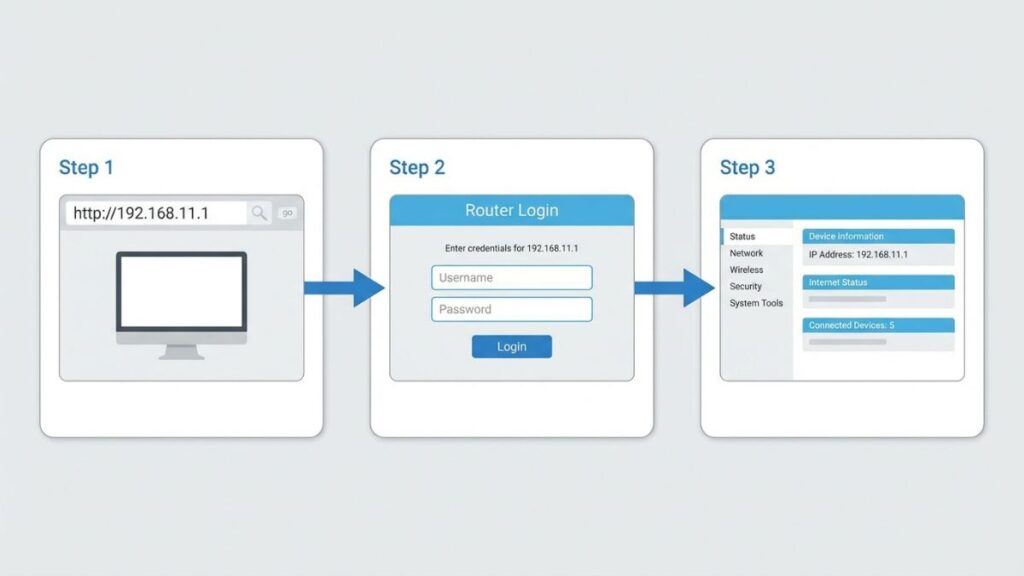
If you typed 192.168.11.1 into your browser and got hit with a login screen — you’re in the right place. This guide walks you through logging in on a PC, iPhone, or Android phone, explains what to do when it won’t load, covers the factory reset process, and shows you exactly what settings to fix once you’re inside your router panel.
I’ve helped a lot of people through this process, and most issues come down to one or two simple things. Let’s get through it.
Router Access Panel
Type
192.168.11.1
in your browser or click the link to access the router admin page.
It works only when you’re connected to the same Wi-Fi network.
192.168.11.1 is a private IP address — specifically, it’s used as a default gateway address by certain router brands, most notably Buffalo routers, along with some ReadyNet, Sony, ZuniDigital, and CD-R King devices.
Here’s the thing most people don’t know: this address doesn’t exist on the public internet at all. It belongs to a block of reserved private address ranges defined under RFC 1918 private address ranges — the standard that carves out IP space exclusively for local networks. That’s why you can only reach it when you’re connected to your own home or office network. Type it into a coffee shop’s Wi-Fi and you’ll get nothing.
Think of it like the internal phone extension at a company — works fine inside the building, completely unreachable from the outside.
What it does: 192.168.11.1 is your router’s management address. Open it in a browser and you get a login page that leads to your router’s admin panel — the dashboard where you control everything from your Wi-Fi name and password to connected devices, parental controls, port forwarding, and security settings.
Default Credentials for 192.168.11.1
Before you log in, you need a username and password. If you’ve never changed them, try the defaults from the table below. Buffalo is the primary brand for this IP — but other brands sometimes use it too.
Brand
Default Username
Default Password
Buffalo
admin
password
Buffalo (some models)
admin
admin
ReadyNet
admin
admin
Sony
admin
admin
ZuniDigital
admin
admin
CD-R King
admin
admin
TP-Link
admin
admin
Asus
admin
admin
Linksys
admin
admin
D-Link
admin
(blank)
Netgear
admin
password
Tenda
admin
(blank)
Belkin
(blank)
(blank)
💡 Tip: Most reliable method: Flip your router over and check the sticker on the bottom or back. The actual default login for your specific model is printed there. Brand-level defaults in tables like this are a good starting point, but the sticker is always the source of truth.
If these don’t work, the password was likely changed at some point. Jump to the factory reset section below.
How to Log Into 192.168.11.1 on a PC
Step-by-step process to access your router admin panel using 192.168.11.1
Most login failures happen because people type the address into the search bar instead of the address bar. These are different things — the search bar sends you to Google results; the address bar takes you directly to the page.
Make sure your computer is connected to your router — either via Ethernet cable or Wi-Fi.
Open any browser (Chrome, Firefox, Edge, Safari — doesn’t matter).
Click into the address bar at the very top of the browser window.
⚠️ Don’t type it into Google: The address bar is where the website URL usually shows (e.g., https://google.com). Click there, clear it out, and type the IP directly.
Type 192.168.11.1 and press Enter.
A login page should appear. Enter your username and password.
Click Login or Sign In.
You’re in. If you’re not — read the troubleshooting section.
How to Log Into 192.168.11.1 on a Phone
Competitors skip this section entirely. Here’s how to do it on both iPhone and Android separately, because the steps are slightly different.
On iPhone (Safari)
Connect your iPhone to the Wi-Fi network managed by your router.
Open Safari (not the search bar in Settings — use the actual Safari app).
Tap the address bar at the top.
Type 192.168.11.1 and tap Go.
Enter your username and password on the login page.
Tap Login.
💡 Tip: Safari sometimes tries to auto-search if it doesn’t recognize the input. If it goes to a search results page, try typing http://192.168.11.1 with the full prefix.
On Android
Connect your Android phone to your router’s Wi-Fi.
Open Chrome (or any browser you have installed).
Tap the address bar at the top.
Type 192.168.11.1 and tap Go or the arrow key.
The router login screen should load. Enter your credentials.
Tap Login.
📱 Tip: On some Android versions, Chrome may show a “site can’t be reached” warning. If that happens, try switching from mobile data to Wi-Fi in your phone’s quick settings — some phones keep mobile data active in the background and route traffic through that instead.
This is the most common one. 192.168.11.1 only works when you’re on the local network managed by that router. If you’re connected to your neighbor’s Wi-Fi, a guest network from a different device, or you still have mobile data active on your phone — the IP won’t load.
Fix: Disconnect from mobile data on your phone. On a laptop, make sure the Wi-Fi or Ethernet connection is going to this router. Run ipconfig in Windows Command Prompt and look at the Default Gateway line — it should say 192.168.11.1. If it shows a different address, that’s your actual router IP.
2. 192.168.11.1 isn’t actually your router’s IP
Buffalo routers commonly use 192.168.11.1, but not all of them do. If someone changed the default gateway IP after setup, or you have a different brand, your router might be at 192.168.1.1, 192.168.0.1, or another address entirely.
Fix: Open Command Prompt on Windows, type ipconfig, and look for Default Gateway. On a Mac, go to System Preferences → Network → Advanced → TCP/IP. That address is your actual router login IP.
3. You typed it wrong
192.168.11.1 gets mistyped more often than you’d think. People confuse it with 192.168.1.11 or 192.168.1.1. The “11” in the third octet is what makes this address different.
Fix: Type it fresh: 1 9 2 . 1 6 8 . 1 1 . 1. Double-check before pressing Enter.
4. Your browser is caching a broken version
Browsers sometimes cache error states, which means even a correct address can fail to load if the browser “remembers” a previous failure.
Fix: Try a hard refresh — press Ctrl + Shift + R on Windows or Cmd + Shift + R on Mac. Or open an incognito/private browsing window and try again from scratch. If that works, clear your browser cache.
5. The router itself has an issue
Don’t panic — this happens. If the router’s firmware has locked up, or it’s been running for weeks without a restart, the admin panel might simply be unavailable.
Fix: Unplug your router from power. Wait 30 full seconds (not five — actually thirty). Plug it back in and wait another 60 seconds for it to fully boot. Then try 192.168.11.1 again. A power cycle fixes this more often than people expect.
Factory Reset Guide for 192.168.11.1 Routers
If you’ve forgotten your admin password and nothing works, a factory reset is your last option. It wipes the router back to factory defaults — including the IP address, credentials, Wi-Fi name, and all custom settings.
💡 Tip: Back up your settings first if you can. If you can still get into the admin panel, look for a Backup or Export Settings option. This saves your custom configuration so you can restore it after the reset.
What gets wiped:
Admin username and password (reset to defaults)
Wi-Fi name (SSID) and Wi-Fi password
Any port forwarding rules
Parental controls
Static IP reservations
Custom DNS settings
How to reset — Buffalo routers:
Make sure the router is powered on.
Find the Reset button — usually a small pinhole on the back or bottom.
Use a paperclip, SIM ejector pin, or pen tip.
Press and hold for 10–15 seconds until the LEDs blink or the router restarts.
Wait for the router to fully reboot (about 60–90 seconds).
Try logging in at 192.168.11.1 with the default credentials from your router’s sticker.
Hold times by brand:
Brand
Hold Time
Buffalo
10–15 seconds
TP-Link
10 seconds
Netgear
7–10 seconds
Asus
10 seconds
Linksys
10–15 seconds
D-Link
10 seconds
What to Do After You Log In
Getting in is just step one. Here’s what you should actually configure inside your router panel, in order of importance.
1. Change Your Admin Password
This is the first thing you should do. The default admin password is public knowledge — literally anyone can find it in a table like the one above. If you leave it as-is, anyone who gets onto your network can change your settings.
Log into 192.168.11.1.
Look for Administration, System, Management, or Tools in the menu (varies by brand).
Find Admin Password or Router Password.
Enter your current password, then your new one.
Use something you’ll remember but others won’t — a passphrase works well. See how to create a strong password if you’re not sure where to start.
Save and re-login with the new password.
2. Change Your Wi-Fi Password
Go to Wireless Settings or Wi-Fi Settings. Look for the Password, Passphrase, or Pre-Shared Key field. Change it to something strong and unique, then hit Save. Every device on your network will need to reconnect.
3. Switch to WPA2 or WPA3 Security
While you’re in wireless settings, check the Security Mode or Encryption field. If it says WEP or WPA (original), change it to WPA2-Personal at minimum. WPA3 is better if your router supports it — check out WPA2 vs WPA3 if you’re unsure which to pick. WEP is outdated and crackable in under a minute with the right tools.
4. Check Connected Devices
Under DHCP Client List, Connected Devices, or Network Map, you’ll see everything currently on your network. Look for anything you don’t recognize. A device called “Android_abc123” you’ve never seen before is worth investigating. Most routers let you block unknown devices by MAC address right from this screen — how to see who’s on your network covers this in depth if you want to go further.
5. Set Up a Guest Network
A guest network keeps visitors on a separate, isolated network — they get internet access but can’t touch your main network or the devices on it. Our guest network is literally named “GuestWifi” and it’s done the job for years. Look for Guest Network or Guest Zone in your router settings. Most modern routers support it, including Buffalo models.
6. Update Router Firmware
Firmware updates fix security vulnerabilities and sometimes improve performance. Go to Administration → Firmware Update or Advanced → Firmware. Most routers have a Check for Update button. Do this once and then set a reminder to check again every few months. How to update router firmware walks through the process if yours doesn’t have automatic update detection.
Common Misspellings of 192.168.11.1
People type this address dozens of ways. If you’ve tried one of these, that’s probably why it didn’t load:
192.168.11.l
192.168.l1.1
192.168.1.11
192.168.11.l
192.168.111.1
19216811.1
192168111
http//192.168.11.1
192.168.11.1/
The correct address is: 192.168.11.1 — four numbers, three dots, no letters.
Which Brands and ISPs Use 192.168.11.1?
Not all routers use this IP. Here’s how common brands and US ISPs break down:
Tenda — defaults vary by model and firmware version
Frequently Asked Questions
Why does 192.168.11.1 say “page not found”?
You’re either not connected to that router’s network, the IP has been changed, or there’s a browser cache issue. Run ipconfig (Windows) or check System Preferences → Network (Mac) to find your actual Default Gateway IP.
What’s the default password for a Buffalo router at 192.168.11.1?
Most Buffalo routers default to admin / password. Some models use admin / admin. Always check the sticker on the back of your specific router first — it has the exact defaults for your unit.
Can I change the 192.168.11.1 IP address?
Yes. After logging in, go to LAN Settings or Network Settings and look for the Local IP Address or Gateway IP field. You can change it to any valid private IP. Once you save, you’ll need to use the new address to access the panel.
What should I do if I forgot my router admin password?
If you can’t remember the admin password and none of the defaults work, you’ll need to do a factory reset. See the factory reset section above for exact steps. After resetting, the default credentials from the router sticker will work again.
Can I log in to 192.168.11.1 from outside my home?
No. Private IP addresses like 192.168.11.1 are not accessible from the public internet — that’s by design. You have to be physically connected to the router’s network (via Wi-Fi or Ethernet) to reach the admin panel.