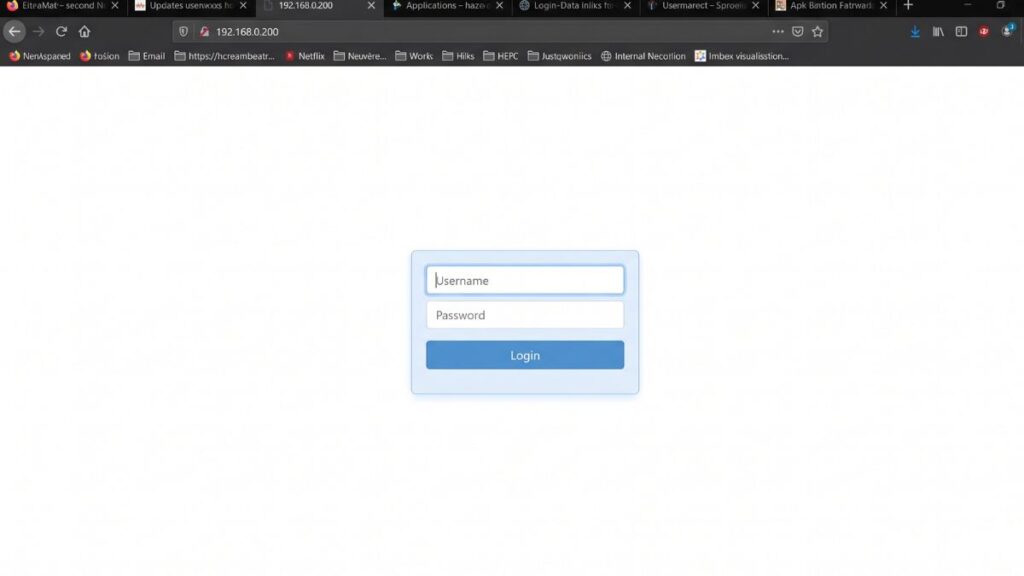
If you’ve typed 192.168.0.200 into your browser and landed here, you’re in the right place. This guide covers everything — how to actually log in (on both PC and phone), what credentials to try, why it might not be loading, and what to do once you’re inside the admin panel. I’ve helped a lot of people through this exact process, and most of the confusion comes from a handful of easily fixed mistakes.
Let’s get into it.
Router Access Panel
Type
192.168.0.200
in your browser or click the link to access the router admin page.
It works only when you’re connected to the same Wi-Fi network.
192.168.0.200 is a private IP address. It sits in the 192.168.0.x subnet, which is one of the three private IP ranges defined in RFC 1918 — the standard that sets aside blocks of addresses for use only inside local networks. That means 192.168.0.200 can never be accessed from the internet. It’s only reachable from devices connected to the same network, whether by Ethernet cable or Wi-Fi.
Most people run into this address in one of two ways:
Their router is configured to use it as a static admin address (less common, but it does happen with certain ISPs and enterprise-grade setups).
A device on their network — like a desktop PC, a NAS, a printer, or a Wi-Fi repeater — has been assigned this IP by their router’s DHCP server, and they’re trying to reach that device’s admin page.
Here’s the thing most people don’t know: 192.168.0.200 is almost never a router’s default gateway address. The typical default gateway in the 192.168.0.x range is 192.168.0.1. If you’re trying to reach your router admin panel and 192.168.0.200 isn’t loading, there’s a good chance your actual gateway is 192.168.0.1 — and we’ll show you how to confirm that in the troubleshooting section below.
That said, some ISPs and network setups do assign 192.168.0.200 as a static admin address, so if you’ve been given this address specifically, the steps below apply.
If your router or network device is actually accessible at 192.168.0.200, you’ll need a username and password to get in. Here are the most common default credentials by brand. The sticker on the bottom or back of your router is always the most reliable source — manufacturers sometimes change defaults between firmware versions or model lines.
Brand
Default Username
Default Password
TP-Link
admin
admin
Asus
admin
admin
Linksys
admin
admin
D-Link
admin
(blank — leave empty)
Netgear
admin
password
Cisco
cisco
cisco
Tenda
admin
admin
Belkin
admin
(blank — leave empty)
ZTE
admin
admin
Huawei
admin
admin
Note:If none of these work, the password may have been changed by whoever set up your network — or it’s printed on a sticker on the device itself. Don’t skip checking the sticker. It takes five seconds and saves you a full reset.
How to Log In on a PC or Laptop
This works on any browser — Chrome, Firefox, Edge, Safari — and on Windows or Mac.
Make sure your computer is connected to the network (either Wi-Fi or Ethernet cable). An Ethernet cable is better if you’re changing settings — you won’t get dropped mid-save.
Open your web browser.
Click in the address bar at the top — not the search box. This is the most common mistake people make. If you type an IP address into the search bar, Google just runs a search. The address bar is where the URL goes.
Type http://192.168.0.200 and hit Enter.
A login page should appear. Enter your username and password.
Click Login or press Enter.
⚠️ Address bar, not search bar. If you see Google or Bing results appear instead of a login page, you typed in the wrong place. Click the address bar at the very top of the browser and try again.
If the page loads but shows an error or times out, jump to the troubleshooting section below.
How to Log In on Mobile
Competitors almost never cover this, but more people manage their routers from a phone now than from a laptop. Here’s how to do it properly on both platforms.
iPhone (iOS)
Open Settings → tap Wi-Fi → make sure you’re connected to your home network.
Open Safari (Safari works most reliably for router admin pages on iPhone).
Tap the address bar at the top.
Type 192.168.0.200 and tap Go.
Enter your username and password on the login page.
Tap Login.
Tip: If Safari asks to save the password, decline. Router admin passwords shouldn’t go into iCloud Keychain.
Android
Open Settings → Network & Internet → Wi-Fi → verify you’re on your home network.
Open Chrome or your preferred browser.
Tap the address bar.
Type 192.168.0.200 and tap Go or hit the Enter key on the keyboard.
Enter your credentials and tap Login.
Note:Some Android browsers (especially Samsung Internet) will try to auto-search an IP address. If you see search results, try adding http:// before the IP: http://192.168.0.200.
Troubleshooting: 5 Common Problems (and Fixes)
If you’re trying to access 192.168.0.200 and the router login page won’t load, you’re not alone. Below are the most common issues and how to fix them quickly.
1. The Page Won’t Load — Just Times Out
Cause: 192.168.0.200 may not be your router’s actual IP address.
Fix: Find your real gateway address. On Windows: open Command Prompt and type ipconfig — look for Default Gateway under your active connection. Mac: go to System Preferences → Network → select your connection → Advanced → TCP/IP tab. iPhone: Settings → Wi-Fi → tap your network → look for “Router.” Whatever address shows up there is your actual gateway — use that instead.
2. Login Page Loads but Credentials Don’t Work
Cause: The default password was changed at some point, or you’re using the wrong brand defaults.
Fix: Check the sticker on the bottom or back of your device — the credentials are almost always printed there. If the sticker is gone and you can’t remember the password, a factory reset is your next option.
3. Browser Says “Connection Refused”
Cause: The web admin interface may be disabled on the device, or HTTP access is blocked (some devices only allow HTTPS).
Fix: Try https://192.168.0.200 (note the “s”). Some routers default to HTTPS-only access. Also check that the device you’re trying to reach has its web interface enabled in its settings — some network devices have this turned off by default.
4. You Can Log In But Can’t Save Any Changes
Cause: Often caused by using a wireless connection — if the router reboots or disconnects Wi-Fi mid-save, you lose the session.
Fix: Connect via Ethernet cable before making changes. It’s a simple habit that prevents a lot of headaches. Don’t panic — nothing is permanently broken; just reconnect and try again with a wired connection.
5. IP Address Conflict — Two Devices on the Same Address
Cause: If how DHCP assigns IP addresses on your network results in 192.168.0.200 being given to a device dynamically at the same time it’s set as a static address for another device, you’ll have a conflict. Both devices become unreachable at that address.
Fix: Log into your router (at its default gateway — usually 192.168.0.1) and look at the DHCP reservation table. Either set 192.168.0.200 as a static/reserved address for only one device, or change the DHCP range so it doesn’t include .200.
Factory Reset Guide
If you’re completely locked out and no credentials work, a factory reset gets you back in — but it wipes everything. Before you touch that reset button, understand what you’re wiping:
Wi-Fi name and password (back to factory defaults)
Admin username and password
Any port forwarding rules
Custom DNS settings
Guest network settings
Parental controls
Back up first if you can — most routers have a backup/export option in the admin panel under System or Administration.
To reset:
Find the reset button — usually a small recessed hole on the back or bottom of the device. You’ll need a paperclip or pin.
With the router powered on, press and hold the reset button.
Hold time varies by brand:
TP-Link: 10 seconds
Netgear: 7 seconds (until the Power light blinks amber)
D-Link: 10 seconds
Asus: 5–10 seconds (until the power LED flashes)
Tenda: 5 seconds
Release and wait 60–90 seconds for the router to fully reboot.
Log in with the factory default credentials printed on the sticker.
What to Do After You Log In
Getting into your router is step one. Here’s what you should actually do once you’re in.
1. Change the Admin Password
Leaving the default admin password is one of the most common home network mistakes. Anyone on your Wi-Fi can reach the admin panel and change whatever they want. Fix it now.
Go to Administration, System, or Management (the label depends on your router brand).
Find Admin Password or Router Password.
Enter your current password.
Enter a new password — use something at least 12 characters long with a mix of letters, numbers, and symbols. Check out the NIST password guidelines for practical advice on what actually makes a password strong.
Save and log back in with the new password.
2. Change Your Wi-Fi Password
Go to Wireless or Wi-Fi Settings.
Find your network (2.4GHz and 5GHz are usually listed separately).
Change the WPA Pre-Shared Key or Password field.
Click Save.
Reconnect all your devices with the new password.
3. Switch to WPA2 or WPA3 Security
If your router is still set to WEP or WPA (the old versions), your network is easy to crack. WPA3 is the current standard — use it if your router supports it. If not, WPA2 is solid. Check the WPA3 security standard to understand what it does and why it matters.
Go to Wireless → Security → change the Security Mode or Encryption setting to WPA2 or WPA3, then save.
4. See Who’s Connected to Your Network
Under Connected Devices, LAN, or Device List, you’ll see every device on your network with its MAC address and IP address. If you see something you don’t recognize, learning what a MAC address is helps you figure out which physical device it belongs to. If you see unfamiliar devices, change your Wi-Fi password.
5. Set Up a Guest Network
A guest network lets visitors get online without giving them access to your main network — and more importantly, without exposing your connected devices (smart TVs, cameras, laptops) to anyone on the guest side. Our guest network is literally called “GuestWiFi” — simple works. Look under Wireless → Guest Network to set it up.
6. Port Forwarding
If you’re running a game server, a home security camera system, or any service that needs to be accessible from outside your network, you’ll need to set up port forwarding. This is under NAT or Advanced → Port Forwarding in most routers. Look up how port forwarding works before diving in — getting the internal IP wrong is the most common setup mistake.
7. Update the Firmware
Router manufacturers regularly release firmware updates that patch security vulnerabilities and fix bugs. Go to Administration → Firmware Update → Check for Updates. The process for how to update router firmware varies slightly by brand, but it’s almost always one or two clicks from this menu. Do it at least once a year.
Common Misspellings of 192.168.0.200
People typo IP addresses all the time. Here are the common wrong variations — if you searched one of these, you meant 192.168.0.200:
192.168.O.200
192.168.0.20
192.168.0.2000
192.168.00.200
192.168.0,200
19216802000
Correct address:192.168.0.200
— Also works as http://192.168.0.200. Double-check for letters vs. zeros and missing/extra dots or digits.
Which Brands and ISPs Use 192.168.0.200
Unlike 192.168.0.1 or 192.168.1.1 — which are common factory default gateway addresses — 192.168.0.200 is rarely a router’s primary default admin address. Here’s how to break it down:
Assigned as static admin address: Some ISP-provided modems/routers in specific regions are pre-configured to use 192.168.0.200 as a fixed management address. This is more common with ISP-configured CPE (customer premises equipment) than with consumer boxed routers.
Assigned dynamically to a device: In networks running DHCP on the 192.168.0.x subnet, any device — a laptop, printer, NAS drive, IP camera, or Wi-Fi extender — could receive 192.168.0.200 as its leased IP address. That device may have its own admin interface at that address.
FAQ
Why is 192.168.0.200 not loading?
The most likely reason is that 192.168.0.200 isn’t your router’s actual gateway address. Open Command Prompt on Windows and run ipconfig — look for “Default Gateway.” That’s the IP you should be using. 192.168.0.1 is more commonly the default in the 192.168.0.x range.
What’s the difference between my Wi-Fi password and my router admin password?
These are completely separate passwords. Your Wi-Fi password is what you type on your phone or laptop to connect to your wireless network. Your router admin password is what you type on the login page at the IP address — it controls the admin interface. Changing one doesn’t change the other.
Can someone outside my house access 192.168.0.200?
No. 192.168.0.200 is a private IP address — it only exists inside your local network. Someone on the internet can’t reach it. Only devices connected to your same Wi-Fi or Ethernet network can access it.
Is 192.168.0.200 safe to use for a static IP assignment?
Yes, as long as you exclude it from your DHCP pool so the router won’t accidentally assign it to another device. Most routers let you configure a DHCP range — set it to end at .199 or start at .201 to keep .200 reserved.
My router login page shows “192.168.0.1” — is 192.168.0.200 the same thing?
No — they’re different addresses on the same subnet. 192.168.0.1 is the most common default gateway in this range. 192.168.0.200 is a different address — likely a device IP or a static admin address, not the router itself.