I’ve helped a lot of people get into their router settings for the first time, and the most common reaction is the same: “That’s it? It was that easy?” Yes — once you know the address. If you’ve landed here, you’re probably trying to reach the admin panel at 192.168.123.1 and not quite sure how. This guide walks you through everything: logging in on a PC, logging in on your phone (iPhone and Android, separately), fixing the most common problems, and what to actually do once you’re inside.
192.168.123.1 – Router Login Admin Page
What Is 192.168.123.1?
The address 192.168.123.1 is a private IP address — specifically, the default gateway address for certain routers and network hardware. Think of it as the front door to your router’s control panel.
It falls inside the 192.168.x.x range defined in the RFC 1918 private address ranges — a set of IP blocks reserved for private, local networks and never routed over the public internet. That’s important to understand: you can only reach 192.168.123.1 from a device that’s already connected to that specific network. If you try to open it on your phone using mobile data (not Wi-Fi), nothing will happen — it simply won’t load.
The “.123.” third octet is less common than 192.168.1.x or 192.168.0.x, which means 192.168.123.1 tends to show up on specific brands and hardware — mostly SMC Networks, Belkin, some Zyxel residential gateways, and certain ISP-supplied modems. More on that in the brands section below.
Most people never think about what is an IP address until something on their network breaks. Now that you’re here, you’re already a step ahead.
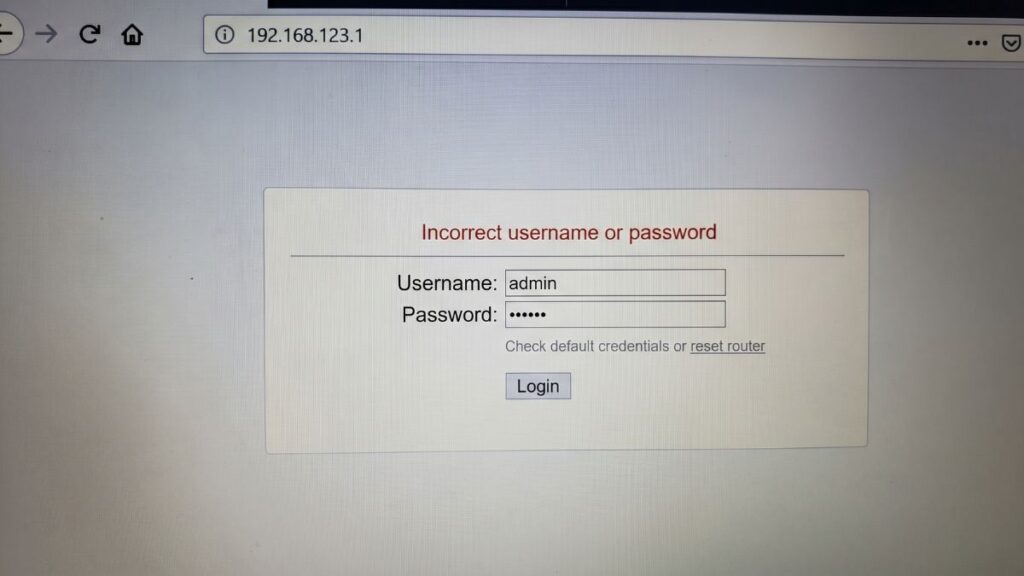
Default Login Credentials for 192.168.123.1
Before you type the address into your browser, you’ll need a username and password. Here are the default credentials for the brands most commonly associated with 192.168.123.1:
| Brand | Default Username | Default Password |
|---|---|---|
| SMC Networks | admin | smcadmin |
| Belkin | (none) | (none — no password required) |
| Zyxel | admin | 1234 |
| TP-Link | admin | admin |
| Asus | admin | admin |
| Linksys | admin | admin |
| D-Link | admin | (blank) |
| Netgear | admin | password |
| Cisco | cisco | cisco |
| Tenda | admin | (blank) |
Most reliable method: Ignore this table and look at the sticker on the bottom or back of your router. Manufacturers print the exact default credentials there — and they vary by model, even within the same brand. The sticker is always right.
How to Log In on a PC (Windows or Mac)
This works the same whether you’re on Chrome, Firefox, Safari, or Edge.
- Connect your computer to the router — either via Ethernet cable or Wi-Fi.
- Open your browser.
- Click in the address bar at the very top of the browser window.
⚠️ Important: Type the IP in the address bar, not the search bar. If you type 192.168.123.1 into Google, you’ll get search results — not your router. The address bar is where the URL goes (it usually shows the website address when you’re on a page).
- Type
http://192.168.123.1and press Enter. - A login prompt will appear — enter your username and password.
- Click Login or OK.
You should now be inside the router’s admin panel. If you get an error instead, skip to the Troubleshooting section.
How to Log In on Mobile
Most guides skip mobile entirely or just say “open a browser.” Here’s exactly how to do it on each platform.
On iPhone (iOS)
- Go to Settings → Wi-Fi and make sure you’re connected to the router’s network (not using cellular data).
- Open Safari (or Chrome if you prefer).
- Tap the address bar at the top.
- Type
192.168.123.1and tap Go. - If a login screen appears, enter your username and password.
iPhone tip: If you’re on iOS 16 or later, Safari sometimes tries to search instead of navigate. If that happens, make sure there’s no extra space after the IP address, and try adding http:// before it.
On Android
- Pull down the notification shade and make sure Wi-Fi is on and connected (not mobile data).
- Open Chrome or your default browser.
- Tap the address bar.
- Type
http://192.168.123.1and tap Go or press the return key. - Enter your credentials at the login screen.
Android tip: Some Android builds show a “This site can’t be reached” warning before loading. This is normal for local IP addresses — tap Try again or just wait a moment.
Troubleshooting: 5 Common Problems (And How to Fix Them)
If you’re unable to access the 192.168.123.1 router login page, you’re not alone. Below are the most common issues users face and how to fix them quickly.
1. The Page Won’t Load At All
Cause: Your device isn’t actually connected to the router, or the router’s IP isn’t 192.168.123.1.
Fix: First, make sure you’re on Wi-Fi or Ethernet — not cellular data. Then verify the router’s actual IP. On Windows: open Command Prompt and type ipconfig. Look for the Default Gateway — that’s your router’s real address. On Mac: go to System Settings → Network → your connection → Details. On iPhone: Settings → Wi-Fi → tap the (i) next to your network → look for Router. If the gateway is different from 192.168.123.1, use that address instead.
2. Wrong Username or Password
Cause: Either the default credentials don’t match your specific model, or someone changed them.
Fix: Check the sticker on the router first. If you’ve changed the credentials and forgotten them, there’s only one option: a factory reset (covered below). Don’t panic — it’s a five-minute fix.
3. Login Page Loads But Login Fails
Cause: The credentials were changed at some point — often by the ISP during installation, or by a previous owner/user.
Fix: Try a few common combinations before resetting: admin/admin, admin/password, admin/1234, and admin/[your Wi-Fi password]. Some ISPs set the admin password to the same thing as the Wi-Fi password by default. If none work, proceed to factory reset.
4. Slow or Unresponsive Admin Page
Cause: Browser extensions, cached data, or an overloaded router.
Fix: Try opening the admin page in an Incognito/Private window — this bypasses extensions and cache. Alternatively, clear your browser’s cache and cookies, then try again. If the router feels sluggish, a quick power cycle (unplug for 30 seconds, plug back in) usually clears things up.
5. “192.168.123.1 Refused to Connect” Error
Cause: The router’s web interface might be disabled on the wireless side, or a firewall is blocking access.
Fix: Try connecting via a wired Ethernet cable directly to one of the router’s LAN ports. Some routers disable web access over Wi-Fi by default as a security measure. If you’re already on Ethernet and still getting the error, the web interface port may have been changed — check your router’s manual for alternate access methods. Understanding what is a default gateway can also help clarify why access sometimes behaves unexpectedly.
Factory Reset: The Nuclear Option (When You Need It)
A factory reset wipes all your custom settings — Wi-Fi name, password, port forwarding rules, everything — and returns the router to factory defaults. It’s the last resort, not the first step.
Before you reset:
- Write down (or screenshot) your current Wi-Fi name and password if you still have access to them.
- Note any port forwarding rules you’ve set up.
- If your ISP gave you special settings, have those handy.
How to reset:
- Find the Reset button on the back or bottom of the router — it’s usually recessed in a small hole to prevent accidental presses.
- With the router powered on, use a paperclip or pin to press and hold the Reset button.
- Hold it for 10–30 seconds depending on brand:
- SMC Networks: Hold 15 seconds
- Belkin: Hold 10 seconds
- Zyxel: Hold 10–15 seconds
- Most other brands: 10–15 seconds works
- Release when the lights flash or the router restarts.
- Wait 60–90 seconds for the router to fully reboot.
- Reconnect and log in with the default credentials from the sticker.
What to Do After You Log In
Getting into the router is just step one. Here’s what actually matters once you’re inside.
Change the Admin Password
This is the most important thing you can do. Every router ships with the same default password — meaning anyone on your network can access the admin panel if you haven’t changed it.
- Find Administration, System, or Management in the router menu (varies by brand).
- Look for Admin Password, Login Password, or Router Password.
- Enter your current password, then your new password twice.
- Save.
Choose something strong — not your Wi-Fi password, not “password123.” The NIST password guidelines recommend using a long passphrase over a short complex one. Something like BlueSkyRouter2026! beats R0uter#1 any day.
Change Your Wi-Fi Password
Find Wireless or Wi-Fi Settings in the menu. Look for the Security Key, Passphrase, or Password field under your 2.4GHz and 5GHz networks. Update both if you have a dual-band router.
One thing most people don’t realize: your Wi-Fi password (what guests type to join your network) and your admin password (what logs you into this control panel) are completely separate. Changing one does not change the other. Keep them different.
Set WPA3 or WPA2 Security Mode
Still on the Wireless page, find the Security Mode or Encryption setting. Set it to WPA3 if your router supports it — it’s the strongest current standard. If you don’t see WPA3, select WPA2-PSK (AES). Avoid WEP and TKIP — these are outdated and easy to crack.
For a deeper comparison, see WPA2 vs WPA3.
Check Connected Devices
Most admin panels have a Connected Devices, Device List, or DHCP Client List page. This shows every device currently on your network — useful for spotting unauthorized users. You’ll see device names, what is a MAC address values, and the IP assigned to each device. If something looks unfamiliar, you can block it or change your Wi-Fi password.
Set Up a Guest Network
If guests frequently use your Wi-Fi, a guest network is worth setting up. It gives them internet access without putting them on the same network as your computers, printers, and smart home devices. Our guest network is literally called “GuestWiFi” — simple works. Look for Guest Network or Guest Zone in the Wireless section. Learn more about how to set up a guest network if you want step-by-step guidance per brand.
Port Forwarding (For Gamers and Home Servers)
If you run a game server, host a website from home, or use remote desktop tools, you may need port forwarding. Find it under Advanced → Port Forwarding or NAT/Firewall. You’ll need to know the local IP of your device and which ports the application uses. How port forwarding works is a good primer if you’re new to this.
Update the Firmware
Router firmware updates fix security holes and bugs. Go to Administration → Firmware Update or System → Software Update. Some routers check automatically; others require you to download the file from the manufacturer’s website and upload it manually. Always update if there’s a newer version available.
Common Misspellings of 192.168.123.1
If the address isn’t loading, double-check you haven’t made one of these common typos:
192.168.123.l
192.168.l23.1
192.168.123.1.1
192.168.12.3.1
192.168.1231
192-168-123-1
http//192.168.123.1
19216812 31
Correct address:
192.168.123.1
— Type it fresh in the address bar rather than copying from a message or document where encoding issues can creep in.
Which Brands and ISPs Use 192.168.123.1?
Brands That Commonly Use This Address
Primary users:
- SMC Networks — SMC’s residential and small-business routers have long used 192.168.123.x as their default subnet. If you have an SMC model, this is almost certainly your gateway.
- Belkin (certain older models) — Some Belkin routers default here, particularly older N-series hardware.
- Zyxel — Specific Zyxel residential gateways, especially ISP-bundled variants.
Sometimes use this address:
- Certain Huawei ISP gateway models (varies by country and ISP)
- Some ZTE residential modems
- Older 2Wire DSL gateways (primarily AT&T-branded equipment)
Use a different address (not 192.168.123.1):
- TP-Link → typically 192.168.0.1 or 192.168.1.1
- Netgear → typically 192.168.1.1 or 192.168.0.1
- Asus → typically 192.168.1.1
- Linksys → typically 192.168.1.1
US ISPs and Their Default Gateway IPs
| ISP | Default Gateway |
|---|---|
| Xfinity / Comcast | 10.0.0.1 |
| AT&T | 192.168.1.254 |
| Verizon Fios | 192.168.1.1 |
| Spectrum | 192.168.1.1 |
| Cox | 192.168.0.1 |
If you’re on Xfinity, AT&T, or Verizon and ended up here, your gateway is almost certainly one of the addresses above — not 192.168.123.1. The exception is if you’ve replaced the ISP’s equipment with your own router and set a custom subnet.
Frequently Asked Questions
What’s the difference between my Wi-Fi password and my admin password?
Your Wi-Fi password is what you type on your phone or laptop to connect to the wireless network. Your admin password is what you type at 192.168.123.1 to log into the router’s control panel. They’re completely separate — changing one doesn’t affect the other. Many security breaches happen because people assume they’re the same and never change the admin password.
Is 192.168.123.1 safe to visit?
Yes. It’s a local IP address on your own private network — it’s your router, not a website on the internet. Nobody outside your network can reach it.
What if I forget my router admin password?
You’ll need to factory reset the router (see the reset section above). There’s no “forgot password” option for router admin panels. That’s by design — it prevents remote recovery attacks.
How do I find out who is connected to my network?
Log into the admin panel at 192.168.123.1 and look for Connected Devices or DHCP Client List. You’ll see every device currently on your network. For more detail, check how to see who’s on your network.
My router shows 192.168.123.254 instead — is that related?
Yes. Some SMC and Zyxel models use 192.168.123.254 as the gateway rather than 192.168.123.1. Both are valid — just use whichever one your router actually shows as the Default Gateway.