Your mobile hotspot or Huawei LTE router uses 192.168.42.1 as its admin address — and most people type it straight into Google and get a page of search results instead of a login screen. That’s the problem. The search bar and the browser address bar are two completely different inputs, and your device only responds to one of them. This page gives you the exact login steps, the correct default credentials by brand, and every fix for when the page refuses to load.
192.168.42.1 Router Login – Admin Page Guide
What Is 192.168.42.1?
192.168.42.1 is a private IP address. It doesn’t exist on the public internet — no website, no server, no external service will ever use this address. The entire 192.168.x.x range is reserved for private use under RFC 1918, meaning it only works inside your local network.
When you type 192.168.42.1 into a browser address bar, you’re not loading a website. You’re sending a direct request to the admin panel built into your device. Mobile hotspots, LTE routers, and some Android tethering interfaces all host a local web server that answers on this address.
This IP is particularly associated with Android’s native USB and Wi-Fi hotspot tethering — when you share your phone’s data connection, Android often assigns 192.168.42.1 as the gateway for connected devices. Huawei LTE CPE routers and mobile Wi-Fi units also use this address in certain configurations. You’ll also find it on some Netgear LTE routers and Franklin Wireless hotspots issued by US carriers.
Devices and Brands Using 192.168.42.1
| Brand / Device | Default Gateway | Notes |
|---|---|---|
| Android hotspot (most brands) | 192.168.42.1 | Wi-Fi and USB tethering gateway |
| Huawei E5577 | 192.168.42.1 | Pocket Wi-Fi / mobile hotspot |
| Huawei E5787 | 192.168.42.1 | 4G LTE mobile Wi-Fi |
| Huawei B310 (some configs) | 192.168.42.1 | LTE CPE home router |
| Netgear LB1120 | 192.168.42.1 | 4G LTE modem router |
| Franklin Wireless R850 | 192.168.42.1 | T-Mobile issued hotspot |
| Franklin Wireless T9 | 192.168.42.1 | T-Mobile 5G hotspot |
| Alcatel LINKZONE 2 | 192.168.42.1 | AT&T and T-Mobile hotspot |
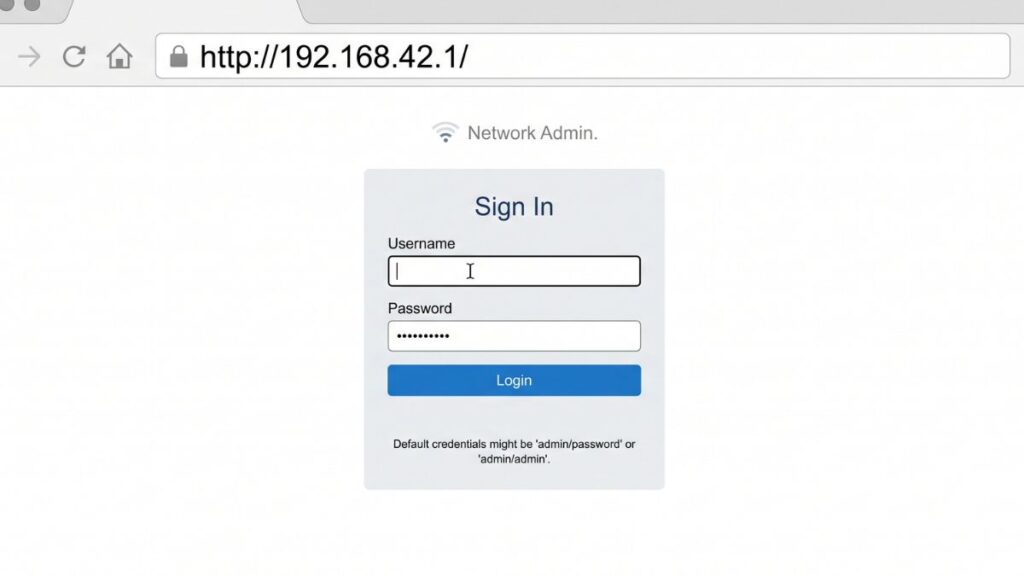
Default Username and Password for 192.168.42.1
| Brand / Device | Username | Password | Likelihood |
|---|---|---|---|
| Huawei E5577 / E5787 | admin | admin | Most Common |
| Huawei (ISP-locked) | admin | (printed on label) | Most Common |
| Netgear LB1120 | admin | password | Most Common |
| Franklin Wireless R850 | admin | (printed on label) | Most Common |
| Franklin Wireless T9 | admin | (IMEI last 8 digits) | Common |
| Alcatel LINKZONE 2 | admin | admin | Most Common |
| Android tethering | — | — | No login required |
| Android (carrier app) | admin | (Wi-Fi password) | Less Common |
The most reliable source is always the label on the side or bottom of your device. Franklin Wireless hotspots — especially T-Mobile-issued units — often use the last 8 digits of the IMEI as the default admin password. That number is printed on the device label and on the box.
⚠️ Android tethering is a special case. When your phone acts as a hotspot, 192.168.42.1 is the gateway for connected devices — but the phone itself doesn’t show a traditional admin panel at that address. Some Android versions and carrier apps do expose a basic web interface there, but most don’t. If you’re trying to reach a phone’s hotspot settings, go directly into your phone’s Settings → Network → Hotspot instead.
Carrier-locked hotspots from T-Mobile and AT&T are increasingly provisioned with device-specific credentials rather than generic defaults. If nothing in the table works, the admin password is almost certainly on the device label — or the device was previously configured and the password changed. A factory reset (Section 5) is the reliable recovery method.
How to Log Into 192.168.42.1
The mistake that stops most people: typing 192.168.42.1 into the Google search bar. Google treats it as a search query. Your device never receives the request. The address bar — the narrow strip at the very top of the browser window, not the search box — is where this needs to go.
On a PC or Mac
- Connect to the hotspot or LTE router’s Wi-Fi network. For some Netgear LTE modems, you can also use an Ethernet cable from the LAN port to your computer — that’s the more reliable option for making configuration changes.
- Open any browser: Chrome, Firefox, Edge, or Safari.
- Click the address bar at the very top of the browser window — not the search bar.
- Type
http://192.168.42.1— include thehttp://prefix. Chrome and Edge now attempt HTTPS on bare IP addresses, and most hotspot admin panels won’t load over HTTPS. - Press Enter.
- Enter your username and password from the table above.
- You’re in.
If Chrome shows a “Your connection is not private” error or tries to redirect to HTTPS, type http://192.168.42.1 explicitly with the prefix and press Enter right away. Don’t let the browser autocomplete — it may try to turn the address into a search query.
On iPhone (iOS)
- Connect to the hotspot’s Wi-Fi network in Settings → Wi-Fi.
- Tap the (ⓘ) icon next to the network name → scroll to the Router field. Confirm it shows 192.168.42.1.
- Turn off mobile data. Your iPhone’s own cellular connection can override Wi-Fi routing and prevent access to the gateway.
- Open Safari — not the Google app, not Chrome. Safari’s address bar handles local IP access more reliably on iOS.
- Tap the address bar at the top.
- Type
http://192.168.42.1→ tap Go. - Enter credentials when the login page appears.
On Android
- Go to Settings → Network & Internet → Wi-Fi → tap the hotspot network name → tap Advanced → look for the Gateway field. On Samsung: Settings → Connections → Wi-Fi → tap network → gear icon → View More.
- Confirm the gateway shows 192.168.42.1.
- Open Chrome → tap the address bar → type
http://192.168.42.1→ tap Go. - Enter credentials at the login prompt.
One thing that catches Android users:if your phone is both the hotspot source and the device you’re trying to configure, you won’t reach 192.168.42.1 through the phone’s own browser — the phone doesn’t route its own traffic through its hotspot interface. Use a second device connected to the hotspot instead.
Troubleshooting: When 192.168.42.1 Won’t Load
If you’re trying to access 192.168.42.1 and the router login page won’t load, you’re not alone. Below are the most common issues and how to fix them quickly.
1. Page Won’t Load at All
Cause: Your device isn’t connected to the hotspot’s Wi-Fi network, or mobile data is overriding Wi-Fi on the device you’re using to access the panel. [dearrouter](https://www.dearrouter.com/192-168-42-1/)
Fix: Confirm 192.168.42.1 is actually your gateway. On Windows, open Command Prompt and run ipconfig — look for “Default Gateway” under your active Wi-Fi adapter. On Mac, ]. On Mac, open Terminal and run route -n get default | grep gateway [help.simpletelly](https://help.simpletelly.com/article/313-how-to-find-your-default-network-gateway-from-mac-osx). If the result shows a different IP, that’s your actual gateway — use that address instead [dearrouter](https://www.dearrouter.com/192-168-42-1/).
2. Wrong Username or Password
Cause: Default credentials changed, Caps Lock is on, or — for Franklin Wireless devices — you haven’t tried the IMEI-based default yet.
Fix: Work through every combination from your manual. For Franklin Wireless T-Mobile hotspots specifically, the admin password is the last 8 digits of the IMEI printed on the label — not admin or password. Check the label before assuming credentials have been changed. And always check Caps Lock first — it causes more failed logins than most people expect.
3. 192.168.42.1 Is Not Your Device’s Gateway
Cause: Your hotspot or LTE router uses a different default gateway. Many mobile hotspots use 192.168.1.1 or 192.168.0.1 instead — this varies by carrier, firmware version, and device model. [en.ipshu](https://en.ipshu.com/ipv4/192.168.42.1)
Fix: Check the actual gateway using the system command methods above before spending any time troubleshooting the wrong address.
How to Find Your Default Gateway
| Device | Path | Command / Setting |
|---|---|---|
| Windows | Start → Command Prompt | ipconfig → Default Gateway |
| Mac | Terminal | route -n get default → result |
| iPhone (iOS) | Settings → Wi-Fi → (ⓘ) → Router | Displayed directly |
| Android | Settings → Wi-Fi → tap network → Advanced | Gateway field |
4. VPN or Browser Extension Is Blocking the Page
Cause: An active VPN reroutes all traffic away from the local network. Ad blockers and privacy extensions can intercept requests to private IP ranges.
Fix: Open an incognito window first — most extensions don’t run there. Disable the VPN entirely. Use the http:// prefix explicitly. If Chrome fails, try Firefox or Edge. Each browser handles local IP requests differently, and switching browsers often resolves the issue without any other changes.
5. Wrong Device for Hotspot Access
Cause: If you’re using a phone as a hotspot, you cannot access the hotspot admin panel from that same phone’s browser. The phone routes its own traffic directly through its cellular connection, not through the hotspot interface it’s broadcasting.
Fix: Use a different device (laptop, tablet, or a second phone) connected to the hotspot’s Wi-Fi. That device will recognize 192.168.42.1 as its gateway, allowing the admin panel to load normally. If you must configure it from the same device, use your phone’s native “Settings → Hotspot” menu instead of a browser.
Factory Reset Guide: Getting Back In When You’re Locked Out
Fair warning — a factory reset wipes everything. Your hotspot name, admin password, any custom DNS settings, connected device records. All of it returns to factory defaults. Write down anything you’ll need to reconfigure before pressing the reset button.
- Locate the reset pinhole — on Huawei mobile hotspots, it’s on the back or side panel. On Netgear LTE routers, it’s on the rear. On Franklin Wireless hotspots, it’s usually on the back behind the battery cover.
- Make sure the device is powered on and fully booted — LEDs should be stable.
- Insert a straightened paperclip or SIM ejector tool into the pinhole.
- Press and hold firmly. Don’t tap — a sustained press is required.
- Hold for the duration shown in Table 4. Watch the LED for the confirmation signal.
- Release when the LED flashes or the device restarts.
- Wait 60–90 seconds for a hotspot to reboot, or 2–3 minutes for a full LTE home router.
- Log in with factory defaults from the label on the device.
Factory Reset by Device
| Device | Hold Time | LED Indicator |
|---|---|---|
| Huawei E5577 | 5 seconds | Screen shows “Restoring” |
| Huawei E5787 | 5 seconds | All LEDs flash, then device restarts |
| Netgear LB1120 | 10 seconds | Power LED flashes amber |
| Franklin Wireless R850 | 10 seconds | Status LED flashes rapidly |
| Franklin Wireless T9 | 10 seconds | Screen shows reset animation |
| Alcatel LINKZONE 2 | 8 seconds | All LEDs flash simultaneously |
| Huawei B310 | 10 seconds | Power LED flashes amber then white |
Franklin Wireless T-Mobile units reconnect to the T-Mobile network automatically after a factory reset — the carrier provisioning is embedded in the firmware. Netgear LTE modems connected to AT&T may need the APN settings re-entered manually after reset: APN broadband, no username or password required for most AT&T LTE plans.
7 Settings Worth Changing Once You’re Inside — in Order of Importance
1. Change the Admin Password
IBM’s 2025 security report found that 86% of router and hotspot admin passwords are never changed from factory defaults. For devices using admin / admin, that’s a publicly known credential — anyone connected to your hotspot can reach 192.168.42.1 and take full control of the device in under a minute.
Change it immediately. On Huawei hotspots: Settings → Device Management → Modify Password. On Netgear LB1120: Advanced → Administration → Set Password. Franklin Wireless: Settings → Device → Change Password. Use at least 12 characters — letters, numbers, and symbols. Store it in a password manager, because a forgotten admin password means a factory reset is the only way back in.
2. Switch Your DNS to Cloudflare or Google
Why does changing DNS at the router level matter more than changing it on each connected device? One setting on the hotspot covers every device that connects — phones, laptops, tablets — instantly, without reconfiguring each one individually.
Your carrier’s DNS logs every domain you request. That query happens before HTTPS encryption — carriers can see which sites you visit even when the content is encrypted. Cloudflare’s 1.1.1.1 averages 14.8ms globally. Google’s 8.8.8.8 runs at 34.7ms. Carrier DNS typically runs 50–100ms, sometimes higher on congested mobile networks. Faster DNS translates directly to faster browsing, especially on first connection.
Cloudflare’s 1.1.1.3 blocks malware domains. Their 1.1.1.2 filters adult content. Both are free and take effect the moment you save. On Huawei hotspots: Advanced Settings → DHCP → DNS. Netgear LB1120: Internet → DNS Servers. On Franklin Wireless: Settings → Network → DNS.
DNS Provider Comparison
| Provider | Primary DNS | Secondary DNS | Privacy | Speed |
|---|---|---|---|---|
| Cloudflare | 1.1.1.1 | 1.0.0.1 | No logging | 14.8ms avg |
| 8.8.8.8 | 8.8.4.4 | Limited logging | 34.7ms avg | |
| OpenDNS | 208.67.222.222 | 208.67.220.220 | Filtered options | ~20ms avg |
| Quad9 | 9.9.9.9 | 149.112.112.112 | No logging | ~20ms avg |
3. Set Wi-Fi Encryption to WPA3 or WPA2-AES
WPA3 cuts successful brute-force attacks by 94% compared to WPA2, according to Wi-Fi Alliance testing. Newer Franklin Wireless 5G hotspots and Huawei E5787 units support WPA3. Older models — the E5577, Alcatel LINKZONE 2, and Netgear LB1120 — top out at WPA2-AES, which is the safe minimum.
Never leave WEP or original WPA active. Both are crackable in under an hour with freely available tools. Huawei hotspots: Settings → Wi-Fi Settings → Security Mode. On Netgear: Wireless → Security Options. On Franklin Wireless: Settings → Wi-Fi → Security.
4. Set a Strong Wi-Fi Hotspot Password
This is more important on a hotspot than on a home router. Home routers sit in one place with a fixed set of neighbors. A mobile hotspot travels with you — cafés, airports, hotels, coworking spaces. Every location brings new potential attackers within range.
Default hotspot passwords on carrier-issued devices are often short — 8 to 10 characters, sometimes all numeric. That’s crackable. Change it to something at least 12 characters long with a mix of letters, numbers, and symbols. On Huawei hotspots: Settings → Wi-Fi Settings → Wi-Fi Password. On Franklin Wireless: Settings → Wi-Fi → Password. Netgear: Wireless → Passphrase.
5. Limit the Number of Connected Devices
Every device connected to your hotspot uses your data plan. Worse — unauthorized devices connected without your knowledge drain both data and battery. Most hotspot admin panels let you set a maximum number of simultaneous connections and view which devices are currently connected.
Check the connected devices list first. (Most people are surprised to find old tablets or laptops they forgot had joined the hotspot automatically.) Then set a connection limit. On Huawei: Settings → Wi-Fi Settings → Max Wi-Fi Users. Franklin Wireless: Settings → Wi-Fi → Max Connections. On Netgear LB1120: Advanced → Wi-Fi Settings → Maximum Wi-Fi Clients.
6. Disable WPS If Available
Not all mobile hotspots expose WPS, but those that do should have it disabled. WPS PIN mode has a documented flaw from 2011 that allows brute-force cracking in hours — the flaw is in the WPS specification itself and was never fixed.
Check for WPS in the advanced Wi-Fi settings of your admin panel. If you see it, disable it. Thirty seconds, no impact on normal device connections. Push-button WPS is marginally safer than PIN mode, but disabling both entirely is the cleanest option.
7. Update the Firmware
Broadband Genie’s 2024 survey found that 52% of router owners have never updated firmware or changed any settings. Mobile hotspots are often neglected even more than home routers — because they’re seen as simple data-sharing tools, not devices that need maintenance.
They do. Carrier-issued hotspots — Franklin Wireless, Alcatel — usually receive firmware updates automatically via the carrier network. You don’t need to do anything. But Huawei and Netgear standalone units require manual checks. On Huawei hotspots: Settings → Device Management → Online Upgrade. On Netgear LB1120: Advanced → Administration → Firmware Update.
Don’t power off the device during a firmware update. On small hotspot hardware, interrupted firmware writes can corrupt the device and require a carrier warranty claim to replace.
Other Default Gateways: Is 192.168.42.1 Really Your Device’s Gateway?
192.168.42.1 is primarily associated with Android tethering and specific mobile hotspot models. Before spending time troubleshooting, confirm it’s actually your gateway using ipconfig on Windows or the Router field in iOS Wi-Fi settings.
Here are the default gateways for common hotspot devices and major US carrier equipment:
| Device / ISP | Default Gateway | Notes |
|---|---|---|
| Android hotspot (most) | 192.168.42.1 | Varies by Android version and carrier |
| T-Mobile Franklin R850 | 192.168.42.1 | Label has IMEI-based password |
| AT&T Netgear Nighthawk M1 | 192.168.1.1 | Different from standard Netgear |
| Verizon Jetpack MiFi 8800L | 192.168.1.1 | Standard Inseego gateway |
| Xfinity / Comcast gateway | 10.0.0.1 | Home router, not hotspot |
| T-Mobile Home Internet | 192.168.12.1 | Nokia and Arcadyan hardware |
| AT&T MiFi (Netgear) | 192.168.42.1 | Some models — confirm on label |
Android tethering is worth a specific note. When your Android phone shares its data connection, the gateway IP assigned to connected devices varies by Android version and carrier customization. Most stock Android versions use 192.168.42.1 for Wi-Fi hotspot and 192.168.42.1 or 192.168.43.1 for USB tethering. Samsung One UI and some carrier-modified Android builds may use different subnets entirely. The only reliable way to confirm: connect a device to the hotspot, then check its gateway using ipconfig or the iOS Wi-Fi details screen.
Common Misspellings of 192.168.42.1
The most common typos are:
192.168.42.l
192.168.421
19216842 1
192.168.4.21
www.192.168.42.1
Correct address:
192.168.42.1
or http://192.168.42.1 — numbers only, three dots, no spaces/letters/www. Use browser address bar (not search), add http:// if needed.
Frequently Asked Questions
What is 192.168.42.1 used for?
It’s the default gateway IP for Android Wi-Fi hotspot tethering, Huawei LTE mobile hotspots, Franklin Wireless T-Mobile devices, and some Netgear LTE routers. Typing it into a browser address bar opens the admin panel — the interface for Wi-Fi name and password, connected devices, DNS settings, and data usage tracking. It only works from inside the hotspot’s local network, not from the internet.
What is the default password for 192.168.42.1?
It depends on the device. Huawei hotspots typically use admin / admin. Netgear LB1120 uses admin / password. Franklin Wireless T-Mobile hotspots often use the last 8 digits of the IMEI printed on the device label as the admin password. Always check the label first — carrier-issued hotspots increasingly use unique per-device passwords rather than generic defaults.
Why won’t 192.168.42.1 open?
Six common causes specific to hotspot setups: you typed it into a search bar instead of the browser address bar; your device is using its own cellular data rather than the hotspot Wi-Fi; you’re trying to access the admin panel from the same phone that’s acting as the hotspot source; your actual gateway is a different IP; a VPN is rerouting traffic; or the device isn’t fully booted. Run ipconfig on Windows or check Settings → Wi-Fi → (ⓘ) → Router on iPhone to confirm the gateway first.
Can I access 192.168.42.1 from my phone?
Yes — but only if your phone is connected to the hotspot as a client, not if your phone is the hotspot source. If you’re trying to manage a Franklin Wireless or Huawei hotspot from your phone, connect the phone to that device’s Wi-Fi first, then open a browser and navigate to http://192.168.42.1. If your phone is the one broadcasting the hotspot, use Settings → Hotspot on the phone itself — you can’t access 192.168.42.1 through your own phone’s browser while it’s the source.